Pharmacy Technician Requirements: What You Need to Get Started
See if you qualify for Pharmacy Technician programs
Answer a few questions in 2 minutes. Free, no commitment.
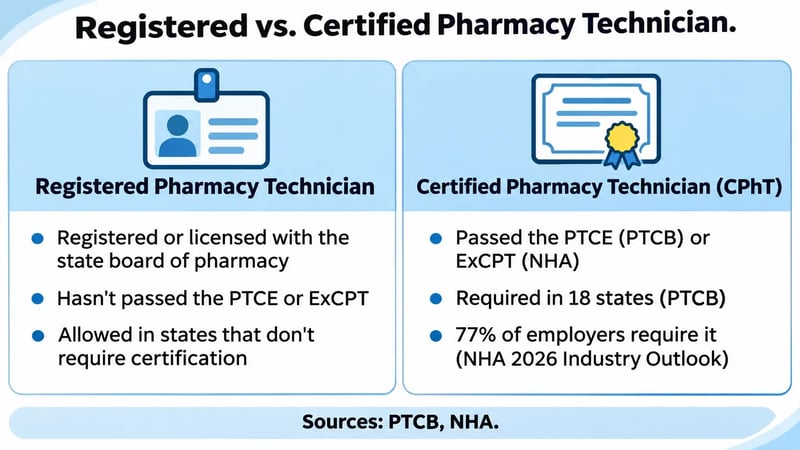
What does it take to be a pharmacy technician? Pharmacy technician requirements usually include a high school diploma or equivalent, on-the-job training or a short postsecondary program, and registration or a license with your state board of pharmacy, which can involve a criminal background check, according to BLS. Some states and employers also require national certification.
The details depend heavily on where you work. Illinois registers technicians from age 16, while New York requires you to be 18 and already certified.
What are the basic requirements to become a pharmacy technician?
Most pharmacy technicians need a high school diploma or equivalent, training on the job or through a program, and registration or a license with their state board of pharmacy. Some states and employers also require national certification through the PTCE or ExCPT.
Can you be a pharmacy tech at 17?
In some states, yes. Florida, Georgia, and Ohio set the minimum age at 17, and Illinois allows registered pharmacy technicians from age 16. New York requires you to be at least 18, so check your own board's age rule before you apply.
Do you need schooling to be a pharmacy tech?
You need a high school diploma or equivalent, but not a college degree. Some states, including Florida and Pennsylvania, require a Board-approved training program, while others let you train on the job.
What disqualifies you from being a pharmacy tech?
A criminal history can, since BLS lists a criminal background check among typical state requirements. Texas, for example, weighs felonies, drug-related offenses, theft or fraud involving drugs, and sex offender registration under the Texas board's criminal offense guidelines, with outcomes ranging from a reprimand to probation or denial. Each board applies its own rules, so ask yours if you have a record.
Do requirements differ by state?
Yes, quite a bit. Certification is required in Texas and New York, while Florida and Pennsylvania require approved training instead. Application fees in the 10 states with the most pharmacy technician jobs run from $30 in North Carolina and Pennsylvania to $175 in New York.
Matching a Pharmacy Technician Program to Your State
Because training rules vary, it helps to choose a program in the state where you plan to work. Dreambound lists programs in several of the states covered above:
- Texas: Southern Careers Institute's Pharmacy Technician program is taught in person at campuses in Brownsville, Corpus Christi, Pharr, and San Antonio and prepares you for the CPhT exam.
- California, Arizona, Idaho, New Mexico, and Washington: Carrington College's Pharmacy Technology program runs at campuses in each of these states, and the school is accredited by the Accrediting Commission for Community and Junior Colleges.
- Nevada, Texas, and California: Asher College's Pharmacy Technician program is taught in person at its Las Vegas campus, prepares you for the PTCE, and includes a 130-hour externship.
- Florida: Northbridge University's Pharmacy Technician diploma is offered in person in Tampa, Kissimmee, and Pembroke Pines.
- Online: CCI Training Center's pharmacy technician course and Ultimate Medical Academy's online A.S. program let you study from home.
Meeting the Requirements for Pharmacy Technician Work
The requirements for pharmacy technician work start the same almost everywhere, with a diploma and some form of training, and then split by state. Your board decides the rest, so look up its rules before you commit to a program.
Once you know what your state expects, compare pharmacy technician programs on Dreambound and choose one that fits those rules and your schedule.