How to Become a Surgical Tech: Steps, Education, and Certification
See if you qualify for Surgical Technician programs
Answer a few questions in 2 minutes. Free, no commitment.
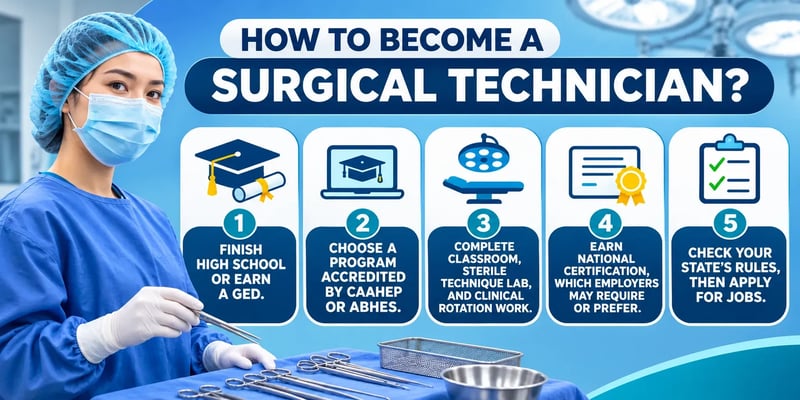
Here is how to become a surgical tech: finish high school or earn a GED, check your state's rules, then choose a surgical technology program accredited by CAAHEP or ABHES. After the coursework and clinical rotations, earn a national certification and start applying for jobs. According to the Bureau of Labor Statistics (BLS), employers may require or prefer certification, and some states regulate the job.
The program you pick matters most, because the Certified Surgical Technologist (CST) exam is open only to graduates of CAAHEP or ABHES accredited programs and to military program graduates. A second exam, the TS-C, accepts a wider set of routes. You will see the job called a surgical tech, a surgical technician, or a surgical technologist, and BLS uses the last of those.
Training Options You Can Compare on Dreambound
Dreambound is a free platform that helps you compare training programs across the United States. The three programs below are listed on Dreambound: two associate degrees and one certificate. None of their program pages names a programmatic accreditor such as CAAHEP or ABHES, so check each one in CAAHEP's search before you apply. Preppy's program prepares you for the TS-C rather than the CST.
Associate Degree Programs
AAS in Surgical Technology - Rockford Career College (Rockford, IL)
- Format: Hybrid
- Length: 18 months (102 quarter credit hours)
- Includes multiple supervised externship modules in hospitals and surgical centers
Surgical Technology Associate's - ECPI University (Manassas, VA)
- Format: Hybrid
- Offered at the Northern Virginia campus in Manassas, with financial aid available to those who qualify
Certificate Program
Online Surgical Tech Certificate - Preppy
- Format: Online
- Length: From 4 months
- Tuition: $1,599 total
- Includes local externship placement at a healthcare facility and prepares you for the NCCT TS-C exam, a different credential from the CST

Frequently Asked Questions
Is it hard to get into a surgical tech program?
Admission difficulty depends on the school and its prerequisites. Skyline College, for example, requires anatomy, medical terminology, and microbiology with a C or better, then admits about 20 students by lottery from the applicants who meet them. Once admitted, you move through classroom, lab, and clinical work.
Can you become a surgical tech without a degree?
Yes, certificate programs exist, and BLS lists a certificate as a typical way in. The difference shows up at the exam: a certificate that prepares you for the TS-C leads to a different credential than an accredited associate degree program that opens the CST. Compare programs on Dreambound to see which credential each one points to.
What is the difference between a surgical technician and a surgical technologist?
BLS uses surgical technologist as the main title and gives operating room technician as another name for the job, and NBSTSA certifies surgical technologists. The sources we reviewed do not define a separate technician role, so read the duties and requirements in a job posting rather than relying on the title. Our guide to what a surgical technician does covers the day-to-day work.
What should I do first if I am still in high school?
Finish your diploma or GED, then check the prerequisites of programs near you before you graduate, so no admission window catches you short. Our guide to steps to take in high school goes further.
Is surgical tech a good career?
It can be a good fit if you like detailed, team-based work in a hospital. Most surgical technologists work in hospitals and spend much of their time on their feet, according to BLS, and employment is projected to grow faster than average.
Your Next Step Toward a Surgical Tech Career
Your program choice decides whether the CST stays open to you, so verify accreditation before anything else.
Compare surgical tech programs on Dreambound by format and length, check each one's accreditation in CAAHEP's search, and look up your state's rules before you apply.